First steps
Since an early age, I have wondered what a scientist does. My relatives did not have an answer for me. They only told me that this career was limited to “really intelligent” or wealthy people. Knowing that I was not born with a silver spoon in my mouth, I realized that I should study hard and go beyond getting good grades. As a young teenager, I applied for a few science contests. And in 2008, when I was 12 years old, I won a bronze medal in the Brazilian Astronomy Olympics. This prize strongly encouraged me to pursue a science career. However, by the time I was studying for college entrance exams, oceanography (not astronomy) attracted me most due to its inherent multidisciplinary nature. In 2015, I was admitted to the University of São Paulo (USP), the most prominent research university in Latin America.
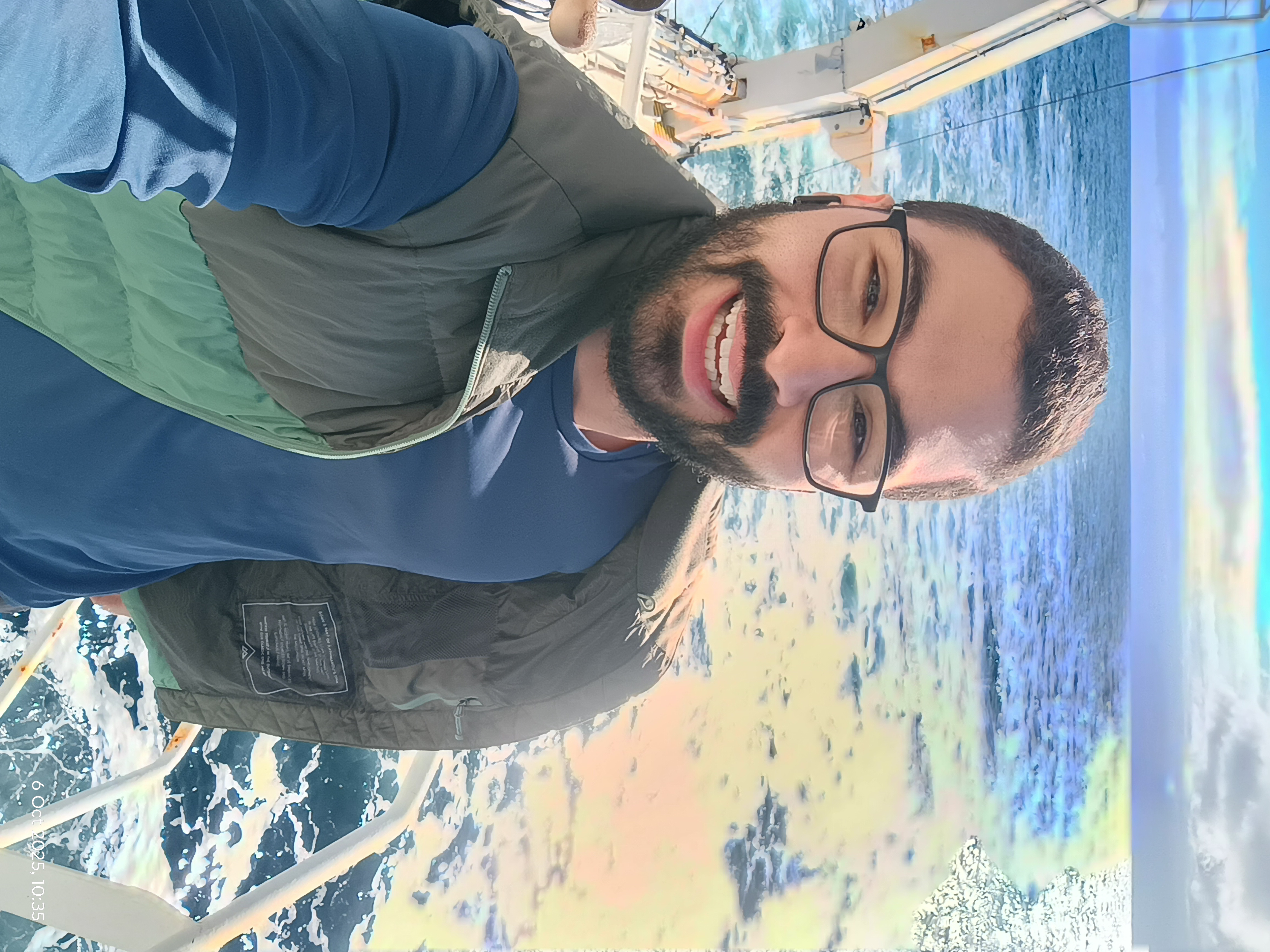
In my second year at USP, Prof. Ilson C. A. da Silveira gave a seminar entitled “Myths and facts about the Brazil Current”. In his talk, Ilson discussed the structure of the Brazil Current, its strong mesoscale eddies, and their role in transporting heat. The study of eddy genesis drew so much my attention that I asked him if I could join his research group, the Ocean Dynamics Laboratory at USP. The Dr. Dante Napolitano (USP in 2020 and now at UBO, FR) also co-supervised my research while at Ilson's lab. As a research assistant, I participated in three oceanographic cruises that investigated the potential of the Trindade and Martin Vaz islands to fertilize the South Atlantic. During these field campaigns, I learned a number of methods for sampling and analyzing oceanographic measurements, including data collected with CTDs, shipboard ADCPs, and LADCPs.
The sea-going experience came in handy while I was in an internship at the University of Massachusetts Dartmouth (UMassD). While at UMassD, Prof. Jeff Turner (UMassD) and Dr. Dennis McGillicuddy (WHOI) invited me to another field campaign to work on grazing experiments for the Shelf break Productivity Interdisciplinary Research Operation at the Pioneer Array off the coast of New England. In addition to the oceanographic sampling during my internship at UMassD from Dec/2018 to Jun/2019, I worked with Prof. Avijit Gangopadhyay on applying objective mapping techniques and feature oriented regional models to study mesoscale ocean currents off Northeast Brazil. Specifically, I worked on validating previously developed feature models for the North Brazil Undercurrent and the Deep Western Boundary Current (DWBC) off northeast Brazil. The preliminary results from this research were published in the conference proceedings of the Anais do OMARSAT and the full study, of which I am a co-author, is published in Journal of Operational Oceanography (Krelling et al., 2020).
In the second part of my honors thesis, the supervisors and I extended the studies about the deep circulation off northeast Brazil to explain the dynamical mechanism responsible for the DWBC breakup into eddies. Our results show that part of the DWBC separates off the continental slope and the breakup is triggered by a hydraulic jump developed as the current negotiates the Pernambuco Plateau, a topographic feature that extends from 7.5$^\circ$S to 9.5$^\circ$S. These findings deepen the understanding of the global ocean circulation and have potential implications for climate. My honors thesis work is published in JGR: Oceans (Vilela-Silva et al., 2023) and was recognized in the Brazilian Conference of Physical Oceanography in 2019, in which I placed second in the \textit{Almirante Franco Prize}, an award given to select oral presentations by graduate and undergraduate students. I also received an honorable mention at the 27$^{th}$ International Scientific Initiation Symposium at USP in 2019.
Working as a Research Assistant at Ilson’s lab for four years (Feb/2016 to Jan/2020) provided me with firsthand experience of the day-to-day activities of a scientist. I now know that scientists gather observations, run experiments, and test hypotheses against data. This process delights me, and I want to build a scientific career in oceanography. Furthermore, my interactions with students in various roles, including as an English Teacher, Environmental Educator, and Teaching Assistant, showed me that a classroom is the space where fascinating questions emerge. Following these motivations, I want to be a researcher and lecturer.